
NOVEMBER 2015
Welcome to my blog featuring textile and fiber art
October was an exciting month, with objects of interest at the Museum of Modern Art (MoMA) and the Metropolitan Museum, plus a lecture in New York by Richard Tuttle, who uses cloth as one of his main materials. But first, my recommendation for book of the month: Fiber: Sculpture 1960-Present (hardcover, 2014), the beautifully illustrated catalogue of a major exhibition of international artists at The Institute of Contemporary Art, Boston. Edited by Jenelle Porter, the publication includes a brilliant essay, “Soft Power,” by Glenn Adamson, Director of the Museum of Arts and Design in New York. Innovative surface-design treatments can be found in many of the images.
Richard Tuttle lectured at the Textile Study Group of New York’s monthly meeting, speaking about influences on his work and about his recent solo show, I Don’t Know, at the Tate Modern’s mammoth Turbine Gallery in London. He brought with him to the meeting samples of the three colors of fabric custom-made in India used to create his Tate installation—bright orange and yellow, and a very deep bluish black—which, for this artist, represent the primary hues of red, yellow, blue. Tuttle first embraced cloth in the 1960s, realizing the potential of textiles to “humanize the world” and attempting to understand “what is the most that this material can achieve” in any given project, while adhering to his minimalist aesthetic. Tuttle has pursued certain “relationships” in textiles, such as between the center and the edge, giving the example of a thick stitched hem contrasting with an open, airy center in a solid green octagonal piece of fabric. While color remains an important element in his textile installations, Tuttle emphasizes structure, explaining that his work can best be understood as sculptural in intent. Richard Tuttle views the world of textiles as “boundlessly infinite” and his recent work at the Tate certainly proved this point.
QUILT GALLERY:
My blog topic on contemporary quilt art for November concerns work that incorporates actual garments or pieces of garments by Yael David-Cohen, Betty Anne Guadalupe, and Diane Savona:
http://www.yaeldc.co.uk
https://thewardrobemeetsthewall.wordpress.com
http://www.dianesavonaart.com
Featuring an actual item of clothing in a work of art instantly imbues the piece with intriguing associations and allusions to the human body, history, and salvaging, in the process of repurposing. In Mending Fossil by Diane Savona, she deconstructed a blouse by opening up the seams, resulting in negative space printed with discharge paste giving instructions on how to mend clothing. Pink Dance by Yael David-Cohen gives new life to a discarded pair of pajamas layered with netting and paint to animate a garment often worn but rarely seen. Betty Anne Guadalupe’s Palette of Jeans transforms a prosaic item of clothing into geometric abstraction while maintaining recognizable pockets, linking the jeans to their wearers as we imagine what the pockets may have contained. Her title also references denim jeans as a commercial commodity, with a pun on “palette’ and “pallet.”
If you would like for your work to be considered for a future Quilt Gallery in my blog, please send me an image along with caption information, photo credit, and a note about your inspiration for the piece. (By emailing the image, you will be giving me permission to use it in the blog and will be responsible for any violation of copyright or trademark regulations.) Recent quilts of all styles will be considered, including contemporary traditional work with an original aspect.
Another quilt caught my eye in October, a vintage Rooster Quilt in the Met’s collection displayed in their small but interesting exhibition American Quilts and Folk Art. During the 1930s, the rooster symbolized the Democratic Party, and the image of a rooster often was printed on voting ballots. The “X” in this quilt represents a vote for the Democratic ticket. At this same time, gridded needlework patterns were very popular, and that format could have influenced the structure of this quilt’s surface, pieced together in many small squares of the same size. As a result, the quilt looks modern to us—rather geometric and with abundant negative space. Not surprisingly, this quilt was made in Indiana, the state where the rooster symbolism originated in 1840 during a campaign when the Whigs lambasted a Democratic candidate for his “crowing.” (The Democrat won the election.)
The Met also exhibited several antique liturgical textiles, and I’m including below a detail from one of them, made in Russia in the 16th or 17th century with elaborate pearl embroidery. The beading vividly outlines lettering in the border, a timeless technique that would be effective today.
MoMA has a fascinating exhibition running until February 28, Take An Object, from a comment that Jasper Johns wrote in his sketchbook in 1964: “Take an object/Do something to it/Do something else to it. (Repeat).” Several pieces in the show consist of textiles or fiber, and I’m sharing images of two of them. Katsuhiro Yamaguchi took flour sacks, patching them together with heavy thread and stretching them onto metal frames to produce amazing sculptural forms that he often installed outdoors. Another Japanese artist, Yayoi Kusama, created vaguely sexualized mundane objects with sewn and stuffed fabric, among many other materials, “obliterating” herself in the process. MoMA is exhibiting her very first soft sculpture, pictured below.
Finally, MoMA brings us a haunting installation by Colombian artist Doris Salcedo in six niches containing women’s shoes partially obscured by stretched cow bladder affixed at the edges with spiky stitches in black surgical thread. She describes the shoes as “stand-ins” for women who disappeared during wartime in the 1960s, and Salcedo explains that she is most interested in “the proximity, the latency of violence” rather than addressing the problem in obvious images. Her work can be seen in the exhibition Scenes for a New Heritage: Contemporary Art from the Collection, open until April 10.
NEWS FLASH:
Independent Art Quilt Workshop taught by Sandra Sider
February 28 – March 4, 2016 (Sunday evening – Friday morning)
This workshop is based on the principles of art and design developed in my critique workshops and written about in the Studio Quilt monograph series. Limited to a maximum of twelve participants, the workshop will allow me to spend considerable amounts of time each day working one-on-one with participants, evaluating their work and suggesting possible directions for developing each quilt. The final day will consist of critiques, with participants sharing and discussing their works in progress. Quilters should bring a work in progress or materials to begin a new quilt, their sewing supplies and tools, a sewing machine and an iron. This class is suitable for all levels of quilters, but excellent sewing skills and expertise with one’s sewing machine is a must. Please email me if you have any questions: sandrasider@mac.com
The class will be held in the beautiful new Art Space at Stony Point Center, located about an hour north of New York City: http://stonypointcenter.org
Tuition for the entire week is $500. Total cost is dependent on the lodging selected, from $450 to $775. It does include all meals. To register: www.stonypointcenter.org/quilting

Xenobia Bailey, Sistah Paradise’s Great Wall of Fire Revival Tent (1993/1999/2009), acrylic and cotton yarn, 144 x 60 x 60 in. (p. 185 in Fiber: Sculpture 1960-Present, photographed 2009 in the John Michael Kohler Arts Center, Sheboygan, Wisconsin)

Richard Tuttle’s installation, Tate Modern, I Don’t Know

Yael David-Cohen, Pink Dance, 2015, 68 x 49 in. Photo by Max Alexander

Diane Savona, Mending Fossil, 2008, 50 x 32 x 2 in.

Detail of Savona’s Mending Fossil
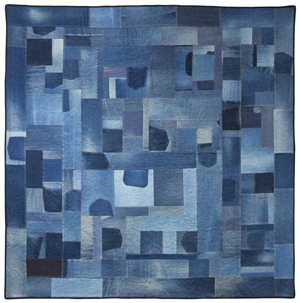
Betty Anne Guadalupe, Palette of Jeans, 2004, 73.5 x 73.5 in. Photo by Paige Vitek

Mary Clara Milligan Kindler Moore, Rooster Quilt, Huntington, Indiana, 1932-33, cotton: Collection of the Metropolitan Museum of Art, New York

Detail of liturgical vestment, Russia, 16th-17th century. Pearl embroidery: Collection of the Metropolitan Museum of Art, New York

Katsuhiro Yamaguchi, Voice, 1963, iron and sack cloth: Museum of Modern Art, New York

Yayoi Kusama, Accumulation No. 1, 1962, sewn stuffed fabric, paint, chair fringe: Museum of Modern Art, New York

Doris Salcedo, Atrabiliarios, 1992-93, one of six niches: Museum of Modern Art, New York
Enjoyed your blog. Loved seeing all the fiber work being shown in NYC. I have always liked Diane Savona’s work. A good way to keep up with what is going on since I am not a facebook person. This is much better.
Thanks, Jane