Textile news

APRIL 2016

March 31st, 2016
Patricia Malarcher, ed. Wings of a Ragtag Quest (2015, Sans Serif Studio), a limited edition of 150 copies on the work of Neil Sonnemann.

Patricia Malarcher, ed. Wings of a Ragtag Quest (2015, Sans Serif Studio), a limited edition of 150 copies on the work of Neil Sonnemann.

Book of the Month

Patricia Malarcher, former editor of the Surface Design Journal, has dedicated several years to editing a book by fiber artist Neil Battle Booker Sonnemann (d. 2004), an important mentor for Martin Puryear and other contemporary artists.  During the final three decades of her life, Sonnemann traveled the world to collect and study appliqued textiles.  Her collection of 500 examples from 30 countries is housed at the Gregg Museum at North Carolina State University, Raleigh. Titled Wings of a Ragtag Quest and published in 2015 by Sans Serif Studio, this limited edition of 150 copies retails for $250. I include it here because Sonnemann, who was a professor on the art faculty of the Catholic University of America in Washington, D.C., deserves to have her legacy recognized by libraries at universities with textile programs.  While the book’s cost is prohibitive for most book lovers, I hope that you might recommend the publication to a librarian for acquisition.

http://www.vampandtramp.com/finepress/s/Nell-Battle-Booker-Sonnemann.html#wings


Sidnee Snell with her quilt Deterioration Interrupted (2015).

Sidnee Snell with her quilt Deterioration Interrupted (2015).

Sidnee Snell at the Latimer Quilt and Textile Center

Portland artist Sidnee Snell currently has a solo exhibition of more than two dozen quilts at the historic Latimer Quilt and Textile Center in Tillamook, Oregon. She developed her signature style by interpreting her photographs in layers of stitched shapes. The visual effect suggests densely textured impressionist watercolors as Snell deftly manipulates illusions of light and depth. The exhibition closes on April 30, and the artist chose not to define this grouping of her work with a formal title.

http://www.sidneesnell.com/about/


Patricia Montgomery, story quilt for Jo Ann Gibson Robinson concerning the Montgomery bus boycott that lasted for more than a year.

Patricia Montgomery, story quilt for Jo Ann Gibson Robinson concerning the Montgomery bus boycott that lasted for more than a year.

Patricia Montgomery, story quilt for Amelia Boynton Robinson depicting the Pettus Bridge in Selma.

Patricia Montgomery, story quilt for Amelia Boynton Robinson depicting the Pettus Bridge in Selma.

Patricia Montgomery Celebrates Heroines of the Civil Rights Movement

Until April 30, the The Brick House Gallery & Art Complex in Sacramento is featuring Oakland artist Patricia A. Montgomery’s tribute to mostly unsung Civil Rights heroines. (I saw the show last month in Oakland and found it extremely powerful!) Through 20 story quilts created in women’s swing coats tailored by her, the artist used photographic processes, pastels, and various quilting and stitching techniques to carry the narratives. This exhibition by a master quilter emphasizes the historic bus boycott in Montgomery, Alabama, where Rosa Parks refused to relinquish her seat in December of 1955. The African-American women recognized include Jo Ann Gibson Robinson, organizer of the Montgomery bus boycott supported by Martin Luther King, Jr.; Diane Nash, a Fisk University student who led the sit-in at the lunch counter in the Nashville Woolworth’s; and, Amelia Boynton Robinson, who was viciously beaten by police during the first attempt to march in protest for voting rights across the Pettus Bridge. Patricia Montgomery explains why her canvas is the swing coat: “When I was young one of my favorite coats was the swing coat. Every time I would sew an outfit, I would create a version of a swing coat.  When I designed this project, the swing coat offered a lot more surface to use to tell each woman’s story. Also, women wore this type of coat during the Civil Rights period. When the coats are grouped together in the gallery space, they represent the spirit and energy of the women celebrated.” Montgomery produced this exhibition with a Creative Work Fund Grant, a program of the Walter and Elise Haas Fund supported by generous grants from the William and Flora Hewlett Foundation and the James Irvine Foundation.

http://www.sacramento365.com/org/detail/6803/The_Brickhouse_Gallery

Marion Coleman and Joyce Gordon Gallery curator Eric Murphy in front of Hands Up Don't Shoot by Jackie Houston. To the right can be seen part of Graffiti Art by Frances Porter.

Marion Coleman and Joyce Gordon Gallery curator Eric Murphy in front of Hands Up Don’t Shoot by Jackie Houston. To the right can be seen part of Graffiti Art by Frances Porter.

Selections from the African-American quilt exhibition at Laney College in Oakland (left to right): Carrots & Friends by Lovenia Fuston, Oakland Nights by Barbara Fuston (they are mother and daughter), Sunburst Beauty by Benita Jones, and Trail Blazers by Marion Coleman.

Selections from the African-American quilt exhibition at Laney College in Oakland (left to right): Carrots & Friends by Lovenia Fuston, Oakland Nights by Barbara Fuston (they are mother and daughter), Sunburst Beauty by Benita Jones, and Trail Blazers by Marion Coleman.

Quilts Galore Around Oakland

Organized by the African American Quilt Guild of Oakland and managed by quilt artist Marion Coleman, Neighborhoods Coming Together: Quilts Around Oakland is bringing dozens of contemporary quilts to at least six venues around Oakland, California. Many of the pieces relate to Oakland as a place and as a state of mind. For the month of April the Joyce Gordon Gallery downtown offers art quilts by fifteen makers, with the works on facing walls, resulting in a stimulating visual dialogue of imagery and themes. Laney College, also in downtown Oakland, has an exhibition of quilts from members of the African American Quilt Guild hanging from the balconies of the library, along with a group of community quilts at eye level. These displays provide such a lively environment for library visitors that the show has been extended through April. Finally, The Sew n Sews Present displays 24 quilts on the support piers and walls of the Alameda County Law Library in downtown Oakland (first floor), an appealing exhibition of work by members of the African American Quilt Guild on view until April 25.

http://joycegordongallery.com/

http://aclawlib.wordpress.com/2016/02/03/those-sew-n-sews-quilts-from-oakland-artists-coming-to-acll/

 Oakland Quilt Project http://www.aaqgo.org/AAQGO/?page_id=756


Gayle Fraas and Duncan Slade, March Island (triptych, 1986), and Michael James, Metamorphosis (1983). On view until June 19 at the Baltimore Museum of Art. Courtesy of the Baltimore Museum of Art. Photo by Mitro Hood.

Gayle Fraas and Duncan Slade, March Island (triptych, 1986), and Michael James, Metamorphosis (1983). On view until June 19 at the Baltimore Museum of Art. Courtesy of the Baltimore Museum of Art. Photo by Mitro Hood.

New Arrivals: Art Quilts at the Baltimore Museum of Art

This small but exquisite exhibition presents five recent acquisitions in the medium of art quilts at the Baltimore Museum of Art. The exhibition title plays on the idea of quilts being relatively new arrivals in the art world as well as being new acquisitions. Michael James, Adrien Rothschild, Elizabeth Scott, Gayle Fraas and Duncan Slade, and Pamela Studstill have works in the show.   On May 14 at 2:00, quilt scholar Bob Shaw will offer a free public lecture at the Museum on “A History of the Art Quilt.” This exhibition will run until June 19, and admission is free. I find it exciting that a major museum is increasing its holdings in contemporary textile art!

https://artbma.org/exhibitions/2015-new-arrivals-art-quilts

What about YOUR work? Don’t forget to send notices of any major solo exhibitions and publications for possible mention in my next blog. This month is all about quilts, but my interests include all contemporary artwork in textile and fiber.


MARCH 2016

February 28th, 2016

Book of the Month

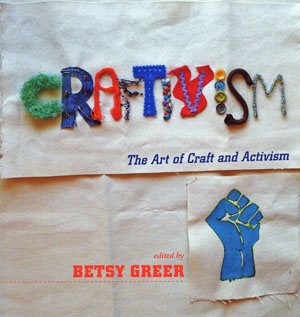
Betsy Greer, ed. Craftivism: The Art of Craft and Activism (2014, Arsenal Pulp Press, Vancouver). Front cover, a textile trompe l’oeil, with the image actually printed on a flat sheet of heavy paper.

Betsy Greer, ed. Craftivism: The Art of Craft and Activism (2014, Arsenal Pulp Press, Vancouver). Front cover, a textile trompe l’oeil, with the image actually printed on a flat sheet of heavy paper.


Craftivism: The Art of Craft and Activism edited by Betsy Greer describes more textile and fiber pieces than any other medium. If you want to understand the lifelong impact that a communal art/craft project can have, just read the essay in this excellent book by L.J. Roberts on her experience of walking through the NAMES Quilt on the Washington mall when she was a young teenager. Namita Gupta Wiggers sums up the power (and yes, potential fun) of Craftivism on the back cover: “Betsy Greer reminds us that revolutions are small before they are grand. In the spirit of craftivism, she gives voice to others, sharing their stories to demonstrate how collaborations—as much as action and listening—can effect change.”


Lesley Turner, Forest Reliquary [top half], 2014 (28 x 16 in.), vintage tablecloth, earth dyes, leaf skeletons, deer bones, maple samaras, fern spores; earth dyeing, spore printing, hand stitching.

Lesley Turner, Forest Reliquary [top half], 2014 (28 x 16 in.), vintage tablecloth, earth dyes, leaf skeletons, deer bones, maple samaras, fern spores; earth dyeing, spore printing, hand stitching.

Surface Design Association Show Touring Canada

Edge of the Forest features textile art by 53 Canadian makers working in printing, felting, quilting, weaving, various types of hand stitching, and other techniques. As the artists engaged with the sylvan theme of the show, they produced textured, colorful works resplendent with images and intimations of leaves, branches, bark, twigs, flowers, etc. The next venue to host the exhibition is located in Victoria, BC.

http://edgeoftheforest.ca/


Heather Debreuil, Open Window – Cesis, 2014 (24 x 18 in.), hand-dyed batik, cotton, Misty Fuse. Inspired by a photograph by Lauma Cenne.

Heather Debreuil, Open Window – Cesis, 2014 (24 x 18 in.), hand-dyed batik, cotton, Misty Fuse. Inspired by a photograph by Lauma Cenne.


Heather Debreuil Solo Exhibition

This seems to be a month for Canadian artists! Currently on view at AOE Gallery in the Shenkman Arts Center, Ottawa, is Cityscapes: Collages in Cloth and Stitch by Heather Debreuil. Her very graphic imagery interprets ordinary urban scenes, imbuing them with an iconic presence via her own hand-dyed cotton and bold stitching. The show, presenting 47 pieces, runs through March 13.

www.artsoe.ca


Ebony G. Patterson, installation view from Dead Treez at the Museum of Arts and Design. Photo: Butcher Walsh © Museum of Arts and Design.

Ebony G. Patterson, installation view from Dead Treez at the Museum of Arts and Design. Photo: Butcher Walsh © Museum of Arts and Design.

 Ebony G. Patterson at the Museum of Art and Design, New York

Patterson is one of my favorite artists in the infamous Saatchi collection, working with painting, mixed-media installations, and jacquard photo tapestries. She lives in Jamaica, her place of birth, and Kentucky, teaching painting at the University of Kentucky in Lexington. Her ironically ornamental images and objects at MAD until April 3 concern gender, race, and inequality. This exciting artist is only in her mid-thirties and I’m very curious to see how her work evolves. Patterson’s exhibition Dead Treez is her first solo show at a museum in New York City.

http://madmuseum.org/exhibition/ebony-g-patterson-dead-treez


Cover (detail), Afghanistan, 1900-1950 (silk, wool, cotton; patchwork). The Textile Museum, Washington, D.C. Gift of James W. Lankton.

Cover (detail), Afghanistan, 1900-1950 (silk, wool, cotton; patchwork). The Textile Museum, Washington, D.C. Gift of James W. Lankton.

 Central Asian Textiles on View in Washington, D.C.

One year ago, The Textile Museum’s new building at George Washington University opened, with an impressive 53,000 square feet of galleries. On view until May 29 is a monumental exhibition Old Patterns, New Order: Socialist Realism in Central Asia. While the title may seem a bit dry, the textiles are eye-popping and the museum web site provides an informative gallery guide. (If only all museums could offer their gallery guides online!) Soviet influence in central Asia introduced modernist ideals, and the exhibition grapples with the tension between these ideals and the cultural identity of textile producers.

http://museum.gwu.edu/old-patterns


Creativity Workshop: Art Quilt Inspirations

The rumor is correct! I am finally teaching a week-long workshop based on ten years of critique experience. Coming in late September, Creativity Workshop: Art Quilt Inspirations, with a maximum of only twelve participants. For more information and to register for my workshop, go to:

Stony Point Center


FEBRUARY 2016

January 28th, 2016

Welcome to my blog featuring textile and fiber art

Front cover of Textile Messages, Dispatches From the World of E-Textiles and Education (2013, vol. 62 in the series The New Literacies and Digital Epistemologies, from Peter Lang).

Front cover of Textile Messages, Dispatches From the World of E-Textiles and Education (2013, vol. 62 in the series The New Literacies and Digital Epistemologies, from Peter Lang).


Book of the Month

My recommendation for book of the month is a bit unusual, a selection of essays titled Textile Messages, Dispatches From the World of E-Textiles and Education (2013). Though electronic textiles can be fragile and somewhat difficult to construct, they look like tremendous fun. The text consists of an introduction and fifteen essays divided into three sections: E-Textile Construction Kits; Learning and Designing with E-Textiles; and, E-Textile Cultures and Communities. While more illustrations would have been helpful, the book does include a bibliography and index.


Earth Stories installation view, textile and fiber works by members of Studio Art Quilt Associates. The quilts pictured here (L to R) are by Alicia Merrett, Annie Helmericks-Louder, and Marilyn M. Prucka.

Earth Stories installation view, textile and fiber works by members of Studio Art Quilt Associates. The quilts pictured here (L to R) are by Alicia Merrett, Annie Helmericks-Louder, and Marilyn M. Prucka.


Earth Stories

In January I was lucky enough to view the SAQA Earth Stories exhibition at the San Jose Museum of Quilts and Textiles (San Jose, California). Carolyn L. Mazloomi, who juried the show, praises the “visual strength, degree of technical skill, and intellectually interesting storylines” in the 24 quilts on view. This ambitious exhibition of textile art addresses environmental issues, including the need to increase sustainability.

http://sjquiltmuseum.org/exhibitions.html


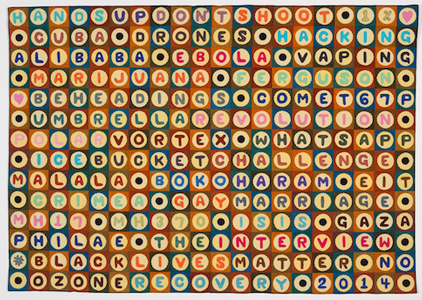
Carol Ann Waugh, 2014 (title of the quilt), 50 x 70 in., in her solo exhibition of five pieces from the artist’s series Conversations: Significant Years installed at aBuzz Gallery in Denver. This quilt was the first one completed of ten pieces in this series, which goes back to 1948, the year of her birth.

Carol Ann Waugh, 2014 (title of the quilt), 50 x 70 in., in her solo exhibition of five pieces from the artist’s series Conversations: Significant Years installed at aBuzz Gallery in Denver. This quilt was the first one completed of ten pieces in this series, which goes back to 1948, the year of her birth.

Solo Exhibition by Carol Ann Waugh

During the past year, Colorado artist Carol Ann Waugh has created a fascinating series, Conversations: Significant Years, consisting of words and phrases distinguished by color and tonality within a strict grid format. In the context of a gallery show, the concept of quilts titled by years (1963, 1968, 2014, etc.) prompted numerous conversations and reminiscences by viewers, completing the artist’s purpose in an interactive manner. Waugh explains her Conversations series for my blog readers: “The challenge of this series was doing the research and then selecting specific words and phrases that resonated with my views and interests today—things that happened in the past that had a direct influence on my life or my thinking.  There is a strong thread throughout of women’s issues, as well as politics, science, inventions, literature, war, economics, and pop culture.” The exhibition is on view at aBuzz Gallery (founded by Waugh) in Denver until March 19.

http://www.abuzzgallery.com/

Carol Ann Waugh, detail of 2014.

Carol Ann Waugh, detail of 2014.


Solo Exhibition by Erma Martin Yost

Noho M55 Gallery (New York City) presents Felted Gardens, recent work by Erma Martin Yost from February 16 – March 5. Yost creates a language of symbolic forms inspired by nature. Her Felted Gardens series focuses on the repeating patterns of planting, cultivating, harvesting–then dormancy and rejuvenation. The artist evokes private worlds containing a sense of place, solitude, and contemplation. “Because of their quiet liveliness, Erma Martin Yost’s multi-layered fabric compositions almost seem to need to be watched rather than looked at. Like a glimpse of a forest out a window, or of a garden behind a gate, they play with geometric pattern against a kind of botanical profusion, and repay continual re-inspection, as nuances reveal themselves” (excerpted from an essay by Lois Martin, no relation to the artist).

http://www.ermamartinyost.com

Erma Martin Yost, Seedlings, 12 x 12 x 2.5 in. (2016), in her Felted Gardens series.

Erma Martin Yost, Seedlings, 12 x 12 x 2.5 in. (2016), in her Felted Gardens series.


Royal Hawaiian Featherwork

Until February 28, the De Young in Golden Gate Park, San Francisco, is presenting a remarkable exhibition, Royal Hawaiian Featherwork, of some 75 pieces. I was amazed by the vibrant graphic designs of items on view, intricately stitched from feathers of indigenous birds and plant fiber. Symbols of power and status, these ceremonial objects include capes, cloaks, hats, helmets, and leis.

http://deyoung.famsf.org/exhibitions


Cape, Hawaii, pre-1861 (feathers and fiber). Exhibited at the De Young (Fine Arts Museums of San Francisco). Bernice Pauahi Bishop Museum, Ethnology Collection.

Cape, Hawaii, pre-1861 (feathers and fiber). Exhibited at the De Young (Fine Arts Museums of San Francisco). Bernice Pauahi Bishop Museum, Ethnology Collection.

Feathered helmet, 1789 or earlier (feathers and fiber). Exhibited at the De Young (Fine Arts Museums of San Francisco). Peabody Museum of Archaeology and Ethnology at Harvard University.

Feathered helmet, 1789 or earlier (feathers and fiber). Exhibited at the De Young (Fine Arts Museums of San Francisco). Peabody Museum of Archaeology and Ethnology at Harvard University.


Quilts and Their Makers in the U.S.

For those interested in quilt history and aesthetics, you may want to register for my online lecture series beginning February 1, with registration open through February 7. Just click on the “Online Classes” tab in my blog (to the right) for more information. The only payment is via a donation to the Texas Quilt Museum (I am their curator).

This blog now has more than 600 subscribers! Because my subscribers’ group includes editors, curators, and collectors, not to mention numerous artists around the globe who truly appreciate textiles and fiber, any work mentioned here is getting some nice exposure. Also, be sure to notify me if you are planning to have a solo show anytime soon, and if you come across a recent book that our readers might find useful: sandrasider@mac.com

JANUARY 2016

December 27th, 2015

Welcome to my blog featuring textile and fiber art, and Happy New Year!

My recommendation for book of the month is Natural Processes in Textile Art by Alice Fox, another practical publication from Batsford, in hardcover. With 128 pages, most being illustrated, this book is very detail oriented—not surprising with a world-class embroiderer as the author. While my favorite section explains how to make ink from acorns and walnuts, Natural Processes in Textile Art includes how-to instructions on botanical collecting, natural dyes, eco printing, iron mordant paste, rust prints, and embedding objects.

A New Competition for Fiber Artists Worldwide:

Fiber Art Now for blog

Another excellent recent publication is the exhibition catalog of the 1st Annual Excellence in Fibers, a juried exhibition of 31 works issued in the Winter 2015/16 Fiber Art Now magazine. This stunning array of fiber art exhibited in print format was selected by John D. Hopper, David Revere McFadden, Jane Sauer, and Lena Vigna. The magazine’s color reproductions present the artwork beautifully, and in large enough format to be studied and appreciated. Marcia Young, editor of Fiber Art Now, comments on the exhibition for my January blog: “The level of work we received for the first Excellence in Fibers exhibition exceeded our expectations. The online gallery of entrants who were just shy of making the final list has been posted on our site (http://fiberartnow.net/gallery/). Anyone who subscribes before January 8 will receive this special issue containing the Excellence in Fibers flip book. For Excellence in Fibers 2016, we are doubling the allocated pages in the magazine and breaking down the competition by fiber medium. Each medium will have its own jury. We want to ensure that every fiber medium is evenly represented and that each is being compared to work within the same field. Details will be released on the Fiber Art Now website by March 1 (http://fiberartnow.net/artist-submissions/).”


Installation photo of Art as Quilt: Transitions in Contemporary Textile Media at the Fuller Craft Museum. Pictured (left to right) are works by Sharyn L. Raiche, Janice M. Jones, and Sandra T. Donabed.

Installation photo of Art as Quilt: Transitions in Contemporary Textile Media at the Fuller Craft Museum. Pictured (left to right) are works by Sharyn L. Raiche, Janice M. Jones, Sandra T. Donabed, and Valerie Maser Flanagan.


Art as Quilt Exhibition:

Until January 17, the Fuller Craft Museum is exhibiting 35 works by 27 artists in Art as Quilt: Transitions in Contemporary Textile Media. Juried by California artist Jamie Fingal, the quilts on display explore exciting approaches to the quilt medium through innovative materials and techniques. This regional show by members of Studio Art Quilt Associates residing in Massachusetts and Rhode Island will travel to the Highfield Hall and Gardens in Falmouth, Massachusetts, to be exhibited from April 15 to June 19.

http://www.fullercraft.org


Victoria Findlay Wolfe, Color Play (2015), in the 2016 Modern Quilt Guild juried exhibition at the Texas Quilt Museum.

Modern Quilt Guild at the Texas Quilt Museum:

Karey Bresenhan and Nancy O’Bryant Puentes, co-founders of the Texas Quilt Museum, have selected 25 quilts for the Modern Quilt Guild’s first juried show in a museum venue. This exhibition can be viewed as a touchstone of some of the best work being produced today by MQG members. The show will run from January 7 to March 27, and the museum is located in La Grange, within an hour’s drive southeast of Austin: http://www.texasquiltmuseum.org


If you don’t know about the Fibre Arts Australia newsletter and want to be more informed about the international scene, you can subscribe via this web site: http://www.fibrearts.jigsy.com/e-newsletter This excellent online publication is free of charge. Finally, those of you near Denver may want to go see an exhibition of bark cloth on view for several months:

Vivian Gegewo, Tapa Painting (2004), Papua New Guinea. Collection of the Denver Art Museum, one of the works on view at the museum in Printed and Painted: The Art of Bark Cloth, through August 17.

Vivian Gegewo, Tapa Painting (2004), Papua New Guinea. Collection of the Denver Art Museum, one of the works on view at the museum in Printed and Painted: The Art of Bark Cloth, through August 17.


DECEMBER 2015

December 2nd, 2015

Welcome to my blog featuring textile and fiber art

Cas Holmes, Stitch Stories (2015, Batsford), 128 pages, extensively illustrated, hardcover with a textured cloth finish.

Cas Holmes, Stitch Stories (2015, Batsford), 128 pages, extensively illustrated, hardcover with a textured cloth finish.


My recommendation for book of the month is Stitch Stories by Cas Holmes, a textile artist who teaches in the U.K., well known for her work with found objects. While this book abounds with processes and techniques, an artist just beginning to work in narrative mode will probably find “Seizing Inspiration” as the most useful chapter. From April 16 until July 3, Holmes will have a solo exhibition at Visions Art Museum in San Diego. For more information about her work, see:

http://www.casholmes.textilearts.net/index.html


Linda Friedman Schmidt, Shifting Perception, 2014 (discarded clothing, mounted on wood panel, 12 x12 in.) Copyright Linda Friedman Schmidt, all rights reserved.

Linda Friedman Schmidt, Shifting Perception, 2014 (discarded clothing, mounted on wood panel, 12 x12 in.) Copyright Linda Friedman Schmidt, all rights reserved.


Linda Friedman Schmidt, a artist working in representational mode who uses discarded clothing to “paint” her compositions, recently won the second-place cash prize with her piece Shifting Perception in a prestigious juried competition from the Worcester Polytechnic Institute (Worcester, Massachusetts) open to all contemporary artists.  For the exhibition The Twenty-First Century Body: Thinking Merleau-Ponty In and out of Time, only 17 works were selected worldwide. Schmidt creates hand-hooked compositions that broaden the dialogue between portrait and process, inviting the viewer to rethink the standard hierarchy of art mediums. Her web site is:

www.lindafriedmanschmidt.com


Front of the Museo Fortuny, a palazzo constructed in Venice near the end of the 15th century by the Pesaro family.

Front of the Museo Fortuny, a palazzo constructed in Venice near the end of the 15th century by the Pesaro family.


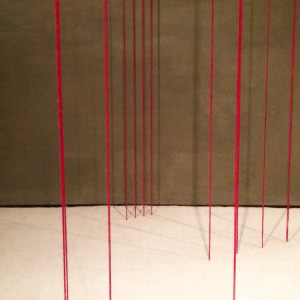
In November, I had the good fortune to spend some time in Venice and visit the Proportio exhibition at the Fortuny Museum, which occupied all levels of the building, along with productions by Mariano Fortuny y Madrazo on permanent display as well as his textile printing studio and several of his stage designs featuring textiles. Proportio, exploring universal proportions in art, science, music, and architecture, was organized to coincide with the 56th Venice Biennale, ending on November 22. I mention the show and palazzo here because several rooms displayed works of art against lengths of luxurious Fortuny fabrics, and the exhibition included a recent tapestry-like creation by El Anatsui shimmering with reflected light, along with an entire room dedicated to a floor-to-ceiling fiber installation in red yarn from the estate of Fred Sandback (d. 2003). His open-form minimalist fiber sculpture has an architectural presence as one enters the space to experience vertical spatial divisions and lines of shadows delineating the floor.

Mariano Fortuny (printed textile motif on silk).

Mariano Fortuny (printed textile motif on silk).

El Anatsui, Revelation, 2014 (aluminum and copper).

El Anatsui, Revelation, 2014 (aluminum and copper).


Fred Sandback, detail.

Fred Sandback, detail.

Fred Sandback, Untitled (Sculptural Study, Sixteen-part Vertical Construction).

Fred Sandback, Untitled (Sculptural Study, Sixteen-part Vertical Construction).


My blog now has many subscribers and I would be happy to respond to your various interests. Please send me an email if you would like to see more writing about a specific area of textile and fiber art: sandrasider@mac.com. I am interested in all of it! Also do let me know if you are a textile or fiber artist having a major solo exhibition during the coming year.


NOVEMBER 2015

November 1st, 2015

Welcome to my blog featuring textile and fiber art

October was an exciting month, with objects of interest at the Museum of Modern Art (MoMA) and the Metropolitan Museum, plus a lecture in New York by Richard Tuttle, who uses cloth as one of his main materials. But first, my recommendation for book of the month: Fiber: Sculpture 1960-Present (hardcover, 2014), the beautifully illustrated catalogue of a major exhibition of international artists at The Institute of Contemporary Art, Boston. Edited by Jenelle Porter, the publication includes a brilliant essay, “Soft Power,” by Glenn Adamson, Director of the Museum of Arts and Design in New York. Innovative surface-design treatments can be found in many of the images.

Richard Tuttle lectured at the Textile Study Group of New York’s monthly meeting, speaking about influences on his work and about his recent solo show, I Don’t Know, at the Tate Modern’s mammoth Turbine Gallery in London. He brought with him to the meeting samples of the three colors of fabric custom-made in India used to create his Tate installation—bright orange and yellow, and a very deep bluish black—which, for this artist, represent the primary hues of red, yellow, blue. Tuttle first embraced cloth in the 1960s, realizing the potential of textiles to “humanize the world” and attempting to understand “what is the most that this material can achieve” in any given project, while adhering to his minimalist aesthetic. Tuttle has pursued certain “relationships” in textiles, such as between the center and the edge, giving the example of a thick stitched hem contrasting with an open, airy center in a solid green octagonal piece of fabric. While color remains an important element in his textile installations, Tuttle emphasizes structure, explaining that his work can best be understood as sculptural in intent. Richard Tuttle views the world of textiles as “boundlessly infinite” and his recent work at the Tate certainly proved this point.

QUILT GALLERY:

My blog topic on contemporary quilt art for November concerns work that incorporates actual garments or pieces of garments by Yael David-Cohen, Betty Anne Guadalupe, and Diane Savona:

http://www.yaeldc.co.uk

https://thewardrobemeetsthewall.wordpress.com

http://www.dianesavonaart.com

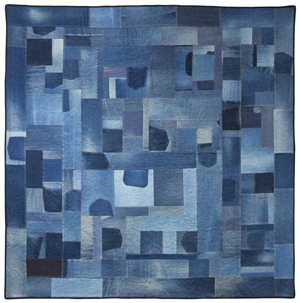
Featuring an actual item of clothing in a work of art instantly imbues the piece with intriguing associations and allusions to the human body, history, and salvaging, in the process of repurposing. In Mending Fossil by Diane Savona, she deconstructed a blouse by opening up the seams, resulting in negative space printed with discharge paste giving instructions on how to mend clothing. Pink Dance by Yael David-Cohen gives new life to a discarded pair of pajamas layered with netting and paint to animate a garment often worn but rarely seen. Betty Anne Guadalupe’s Palette of Jeans transforms a prosaic item of clothing into geometric abstraction while maintaining recognizable pockets, linking the jeans to their wearers as we imagine what the pockets may have contained. Her title also references denim jeans as a commercial commodity, with a pun on “palette’ and “pallet.”

If you would like for your work to be considered for a future Quilt Gallery in my blog, please send me an image along with caption information, photo credit, and a note about your inspiration for the piece. (By emailing the image, you will be giving me permission to use it in the blog and will be responsible for any violation of copyright or trademark regulations.) Recent quilts of all styles will be considered, including contemporary traditional work with an original aspect.

Another quilt caught my eye in October, a vintage Rooster Quilt in the Met’s collection displayed in their small but interesting exhibition American Quilts and Folk Art. During the 1930s, the rooster symbolized the Democratic Party, and the image of a rooster often was printed on voting ballots. The “X” in this quilt represents a vote for the Democratic ticket. At this same time, gridded needlework patterns were very popular, and that format could have influenced the structure of this quilt’s surface, pieced together in many small squares of the same size. As a result, the quilt looks modern to us—rather geometric and with abundant negative space. Not surprisingly, this quilt was made in Indiana, the state where the rooster symbolism originated in 1840 during a campaign when the Whigs lambasted a Democratic candidate for his “crowing.” (The Democrat won the election.)

The Met also exhibited several antique liturgical textiles, and I’m including below a detail from one of them, made in Russia in the 16th or 17th century with elaborate pearl embroidery. The beading vividly outlines lettering in the border, a timeless technique that would be effective today.

MoMA has a fascinating exhibition running until February 28, Take An Object, from a comment that Jasper Johns wrote in his sketchbook in 1964: “Take an object/Do something to it/Do something else to it. (Repeat).” Several pieces in the show consist of textiles or fiber, and I’m sharing images of two of them. Katsuhiro Yamaguchi took flour sacks, patching them together with heavy thread and stretching them onto metal frames to produce amazing sculptural forms that he often installed outdoors. Another Japanese artist, Yayoi Kusama, created vaguely sexualized mundane objects with sewn and stuffed fabric, among many other materials, “obliterating” herself in the process. MoMA is exhibiting her very first soft sculpture, pictured below.

Finally, MoMA brings us a haunting installation by Colombian artist Doris Salcedo in six niches containing women’s shoes partially obscured by stretched cow bladder affixed at the edges with spiky stitches in black surgical thread. She describes the shoes as “stand-ins” for women who disappeared during wartime in the 1960s, and Salcedo explains that she is most interested in “the proximity, the latency of violence” rather than addressing the problem in obvious images. Her work can be seen in the exhibition Scenes for a New Heritage: Contemporary Art from the Collection, open until April 10.

NEWS FLASH:

Independent Art Quilt Workshop taught by Sandra Sider

February 28 – March 4, 2016 (Sunday evening – Friday morning)

This workshop is based on the principles of art and design developed in my critique workshops and written about in the Studio Quilt monograph series. Limited to a maximum of twelve participants, the workshop will allow me to spend considerable amounts of time each day working one-on-one with participants, evaluating their work and suggesting possible directions for developing each quilt. The final day will consist of critiques, with participants sharing and discussing their works in progress. Quilters should bring a work in progress or materials to begin a new quilt, their sewing supplies and tools, a sewing machine and an iron. This class is suitable for all levels of quilters, but excellent sewing skills and expertise with one’s sewing machine is a must. Please email me if you have any questions: sandrasider@mac.com

The class will be held in the beautiful new Art Space at Stony Point Center, located about an hour north of New York City: http://stonypointcenter.org

Tuition for the entire week is $500. Total cost is dependent on the lodging selected, from $450 to $775. It does include all meals. To register: www.stonypointcenter.org/quilting

Xenobia Bailey, Sistah Paradise’s Great Wall of Fire Revival Tent (1993/1999/2009), acrylic and cotton yarn, 144 x 60 x 60 in. (p. 185 in Fiber: Sculpture 1960-Present, photographed 2009 in the John Michael Kohler Arts Center, Sheboygan, Wisconsin), in Fiber: Sculpture 1960 - Present

Xenobia Bailey, Sistah Paradise’s Great Wall of Fire Revival Tent (1993/1999/2009), acrylic and cotton yarn, 144 x 60 x 60 in. (p. 185 in Fiber: Sculpture 1960-Present, photographed 2009 in the John Michael Kohler Arts Center, Sheboygan, Wisconsin)

A section of Richard Tuttle's installation at the Tate Modern.

Richard Tuttle’s installation, Tate Modern, I Don’t Know

Yael David-Cohen, Pink Dance, 2015, 68 x 49 in. (center section)

Yael David-Cohen, Pink Dance, 2015, 68 x 49 in. Photo by Max Alexander

Diane Savona, Mending Fossil, 2008, 50 x 32 x 2 in.

Diane Savona, Mending Fossil, 2008, 50 x 32 x 2 in.

Detail of Savona's Mending Fossil

Detail of Savona’s Mending Fossil

Betty Anne Guadalupe, Palette of Jeans, 2004, 73.5 x 73.5 in. Photo by Paige Vitek

Betty Anne Guadalupe, Palette of Jeans, 2004, 73.5 x 73.5 in. Photo by Paige Vitek

Mary Clara Milligan Kindler Moore, Rooster Quilt, Huntington, Indiana, 1932-33, cotton: Collection of the Metropolitan Museum of Art, New York

Mary Clara Milligan Kindler Moore, Rooster Quilt, Huntington, Indiana, 1932-33, cotton: Collection of the Metropolitan Museum of Art, New York

Detail of liturgical vestment, Russia, 16th-17th century. Pearl embroidery: Collection of the Metropolitan Museum of Art, New York

Detail of liturgical vestment, Russia, 16th-17th century. Pearl embroidery: Collection of the Metropolitan Museum of Art, New York


Katsuhiro Yamaguchi, Voice, 1963, iron and sack cloth: Museum of Modern Art, New York

Katsuhiro Yamaguchi, Voice, 1963, iron and sack cloth: Museum of Modern Art, New York


Yayoi Kusama, Accumulation No. 1, 1962, sewn stuffed fabric, paint, chair fringe: Museum of Modern Art, New York

Yayoi Kusama, Accumulation No. 1, 1962, sewn stuffed fabric, paint, chair fringe: Museum of Modern Art, New York

Doris Salcedo, Atrabiliarios, 1992-93, one of six niches: Museum of Modern Art, New York

Doris Salcedo, Atrabiliarios, 1992-93, one of six niches: Museum of Modern Art, New York


OCTOBER 2015

October 2nd, 2015

Welcome to my blog featuring textile and fiber art

I hope that you enjoy my first monthly blog!  Each month you will see my recommendation for an inspiring book.  This month’s selection, Textileart, can be purchased via: http://www.textile-link.com  The texts are in English, German, and Dutch, and the illustrations are excellent.

You will notice than none of this month’s featured artwork contains actual textiles.  But I find myself inspired by textile motifs in the works of Alicia McCarthy, a member of The Mission School group in San Francisco who embraces the “urban rustic” aesthetic, often repurposing discarded materials.  Here is Roberta Smith’s review of McCarthy’s current NYC gallery exhibition:

http://www.nytimes.com/2015/10/02/arts/design/alicia-mccarthy-expands-her-illusions-in-new-work.html

Elias Sime’s monumental patchwork collages of discarded electronics, wire, buttons, etc. stimulate my eye in the same way as the “tapestries” of El Anatsui.  Holland Cotter, who, like Roberta Smith, has a true appreciation of textile and fiber art, reviewed Sime’s current NYC gallery exhibition:

http://www.nytimes.com/2015/10/02/arts/design/elias-sime-recycles-discarded-objects-into-abstract-works.html

If you would like to learn more about Elias Sime, see this wonderful video:

http://www.nytimes.com/video/multimedia/1194839021231/elias-sime-documentary-excerpt.html

In September I came across the painted paper collages of mixed-media artist Kathleen Beebe Durst, whose work was being exhibited at the Copper Shade Tree gallery in the small but alluring town of Round Top, Texas. She focuses on interpreting animals through strips and sheets of torn paper, an interesting technique that could be applied to fabric.   http://durstudio.com/

http://coppershadetree.com/

Ellen Bakker, Textileart Around the World, 2015, hard cover. 800 images featuring 160 artists.

Ellen Bakker, Textileart Around the World, 2015, hard cover. 800 images featuring 160 artists.

Alicia McCarthy, Detail from Untitled (2015), painting on wood. Roberta Smith in the NY Times: "handmade quirkiness" and "loosely woven grids."

Alicia McCarthy, Detail from Untitled (2015), painting on wood. Roberta Smith in the NY Times: “handmade quirkiness” and “loosely woven grids.”

Elias Sime [See-may], Detail fromTightrope 7, a floor-to-ceiling collage of reclaimed items, including buttons. Holland Carter in the NY Times: "pieced together from individual blocks of dense patterning."

Elias Sime [See-may], Detail fromTightrope 7, a floor-to-ceiling collage of reclaimed items, including buttons. Holland Cotter in the NY Times: “pieced together from individual blocks of dense patterning.”

Kathleen Beebe Durst, Detail from her Crane painted paper collage, 2015. Shown at Copper Shade Tree Gallery, Round Top, Texas (about an hour SE from Austin). This gallery is very fiber friendly!

Kathleen Beebe Durst, Detail from her Crane painted paper collage, 2015. Shown at Copper Shade Tree Gallery, Round Top, Texas (about an hour SE from Austin). This gallery is very fiber friendly!

If you travel to Round Top, Texas, don't miss Royer's Pie Haven. I can personally recommend their chocolate chip specialty.

If you travel to Round Top, Texas, don’t miss Royer’s Pie Haven. I can personally recommend their chocolate chip specialty.


Welcome to my blog featuring textile and fiber art

April 27th, 2015

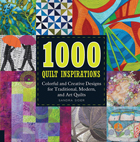
Please note that as of 2016, a somewhat inferior domestic reprint of my book is being distributed.  The paper is not glossy and the images appear faded.  Also, the format has been reduced by five percent, so that many of the images are close to the gutter.  The beautiful original printing states “Made in China.”  The domestic reprint says “Made in the USA.”

1000 QI_cover image_web


To purchase my other quilt-related books, click here